Together with my favorite group-fitness teacher Jennifer Habeeb I made a video for a Social policy class to capacitate community efforts for improving lives of kids in Northwest Philadelphia region. We made the video two days ago and after struggling to upload it to youtube I want to share it with others here.
This is my first video with music and it feels really good because it is for social work. I hope to make many more movies over time towards topics like Ecopsychology (official subject name was introduced to me by my friend Pauline Romas). I have been passionate about our environment for a while: I am a member of Penn-Environment and contribute some money to the organization regularly, I recycle as much as possible even to the point of holding on to the stuff till I find a recycle bin, I use plastic bags only minimally, turn off lights in restrooms in our building at nights, etc. etc. The next revolution for ensuring our civilization is going to be Energy Technology (ET) similar to what we had couple of decades ago with Information Technology (IT). Ecopsychology is going to be ingredient of that progress similar to the progress made along civil rights (civic psychology) of humans.
Friday, December 12, 2008


Thursday, December 11, 2008
The language of thoughts: intelligence, artificial intelligence and super natural intelligence
I wanted to write this post a while ago and then I wanted to write a philosonomicon for my thesis. Because of the deadline yesterday I finally finished the prologue and am using some of it for this post.
Scott already blogged about this almost over two years ago. The basic standard of modern science is that communication is a key aspect in any analytical ability or intelligent activity since it is the first causal step in achieving repeatability leading the eventual goal of our persistence. For communication we need material. Hence materialism is one of the foundations the modern science. Languages evolve over time and the more precise one can communicate the better will be the ability to learn, behave intelligently, lead the food chain and hence survive through odds. Since the beginning of enlightenment era around late 17th century and early 18th century "reason" began to be the basis of authority. Hence the quest to understand human intelligence can be thought to have begun since then.
A hypothesis that is very plausible is that all actions are seeded in thoughts. Our understanding of human intelligence will be limited by our understanding of the language of thoughts. Hence the pursuit of understanding the language of thoughts is well justified.
Understanding Nature for engineering purposes has to do with what is observable, measurable and repeatable with certain level of predictability. Even though logic and math existed for centuries before the advent of computers, a new era of science was ushered by efforts of Alan Turing and Alonzo Church who came up with the famous Church-Turing thesis. Turing's famous paper "On computability..." essentially can be thought of as a heuristic explanation of the human thought process which has proven to be very successful. Thus Turing proposed a language for the machine human interaction. The book "The Language of Machines...", co-authored by my Masters adviser should provide a nice introduction and perspective to the theory of computability.
Turing's famous test for Artificial Intelligence involves modeling thought process as a computational device and comparing it with behavior of a human. Even though computational model of human thought process is only a heuristic it nevertheless models many many human thought processes. With the advent of complexity theory it became apparent that computation may not efficiently model all thought processes as argued by works like Scott's thesis.
But as Niels Bohr once said, "It is wrong to think that the task of physics is to find out how Nature is. Physics concerns what we say about Nature." efforts in artificial intelligence also concern themselves with what we can say about intelligence not what it is. This lead to the modern approaches in machine learning. To summarize the efforts in one long sentence would be to say that those are essentially based on principle of Occam's razor to explain the unknown distributions of observed data using different efficient algorithms and models of data. Different sub-fields (like vision, bio-informatics, medical imaging, robotics etc.) essentially involve in coming up with those efficient algorithms and data modeling. For e.g. artificial vision deals itself with understanding data obtained using electromagnetic waves starting from X-rays (CT-scans) to visible light (photo cameras) to radio waves (MRI). Goals in artificial vision and intelligence thus don't necessarily restrict themselves to human abilities. Humans just form the lower bound of what we want to do with machines (like for e.g. super-man has X-ray vision).
While applied researchers work on developing artifical intelligence that can mimic natural and super-natural intelligence assuming a computational model, complexity theorists work on building computational models and shedding light on their limitations. As long as P!=NP we have to design the learning algorithms for the machines to learn and behave. Understanding the way human brain really works may help to come up with better ("generative") computational models that actually mimic the underlying process generating the human intelligence. But it's a long way to go. Right now Turing model is the most promising because of the enormous creative abilities of humans in designing clever algorithms. Evidently even quantum computation models of thoughts do not give us much more power.
Scott already blogged about this almost over two years ago. The basic standard of modern science is that communication is a key aspect in any analytical ability or intelligent activity since it is the first causal step in achieving repeatability leading the eventual goal of our persistence. For communication we need material. Hence materialism is one of the foundations the modern science. Languages evolve over time and the more precise one can communicate the better will be the ability to learn, behave intelligently, lead the food chain and hence survive through odds. Since the beginning of enlightenment era around late 17th century and early 18th century "reason" began to be the basis of authority. Hence the quest to understand human intelligence can be thought to have begun since then.
A hypothesis that is very plausible is that all actions are seeded in thoughts. Our understanding of human intelligence will be limited by our understanding of the language of thoughts. Hence the pursuit of understanding the language of thoughts is well justified.
Understanding Nature for engineering purposes has to do with what is observable, measurable and repeatable with certain level of predictability. Even though logic and math existed for centuries before the advent of computers, a new era of science was ushered by efforts of Alan Turing and Alonzo Church who came up with the famous Church-Turing thesis. Turing's famous paper "On computability..." essentially can be thought of as a heuristic explanation of the human thought process which has proven to be very successful. Thus Turing proposed a language for the machine human interaction. The book "The Language of Machines...", co-authored by my Masters adviser should provide a nice introduction and perspective to the theory of computability.
Turing's famous test for Artificial Intelligence involves modeling thought process as a computational device and comparing it with behavior of a human. Even though computational model of human thought process is only a heuristic it nevertheless models many many human thought processes. With the advent of complexity theory it became apparent that computation may not efficiently model all thought processes as argued by works like Scott's thesis.
But as Niels Bohr once said, "It is wrong to think that the task of physics is to find out how Nature is. Physics concerns what we say about Nature." efforts in artificial intelligence also concern themselves with what we can say about intelligence not what it is. This lead to the modern approaches in machine learning. To summarize the efforts in one long sentence would be to say that those are essentially based on principle of Occam's razor to explain the unknown distributions of observed data using different efficient algorithms and models of data. Different sub-fields (like vision, bio-informatics, medical imaging, robotics etc.) essentially involve in coming up with those efficient algorithms and data modeling. For e.g. artificial vision deals itself with understanding data obtained using electromagnetic waves starting from X-rays (CT-scans) to visible light (photo cameras) to radio waves (MRI). Goals in artificial vision and intelligence thus don't necessarily restrict themselves to human abilities. Humans just form the lower bound of what we want to do with machines (like for e.g. super-man has X-ray vision).
While applied researchers work on developing artifical intelligence that can mimic natural and super-natural intelligence assuming a computational model, complexity theorists work on building computational models and shedding light on their limitations. As long as P!=NP we have to design the learning algorithms for the machines to learn and behave. Understanding the way human brain really works may help to come up with better ("generative") computational models that actually mimic the underlying process generating the human intelligence. But it's a long way to go. Right now Turing model is the most promising because of the enormous creative abilities of humans in designing clever algorithms. Evidently even quantum computation models of thoughts do not give us much more power.
Wednesday, November 05, 2008
Congratulations to America
Last night was an amazing night! It was much much more exciting than any event I ever followed. I feel fortunate to be right here in the US and be part of this historic election in someway.
The outcome of this election process clearly presents us many many aspects of true America or the concept of America:
For a country to be a true beacon for democracy we need good people who can make the actual definition of democracy (Govt. of the people, by the people and for the people) work.
People should be smart, open and stand for their beliefs, looking beyond their prejudices, to actually tap the full potential of democracy.
The freedom and power that the US has in this world gives room for lot of possibilities and it has been making better choices than almost all powers in the past, this being their latest accomplishment.
The true meaning of the opportunity is best demonstrated with this election.
It's resilience is a true demonstration of the saying: "Our greatest glory consists not in never falling, but in rising every time we fall." -- Ralph Waldo Emerson
The outcome of this election process clearly presents us many many aspects of true America or the concept of America:
Saturday, November 01, 2008
Counting days to 4th
There is space-time continuum in this world but we know that there's no absolute measure of time. Sometimes days feel like seconds and sometimes seconds feel like days. With only two days left for the defining moment in 2008, the days feel like too long! Americans, PLEASE VOTE FOR BARACK OBAMA on November 4th (Tuesday)! Polls sure boost our confidence but please do not let them increase your complacence.
Summarized view of his campaign is below:
Summarized view of his campaign is below:
Monday, October 20, 2008
Polls and Powell
I wanted to add this video with some meta analysis of Obama's campaign style. But I wasn't very sure about it. Looking at Terence Tao's post on the same topic I got motivated again.
See I mentioned before we can learn a lot from Obama's campaign style for better. Obama's self-criticality, empathy, uncertainty actually add to his focusing ability and thus lead to confidence and success at least as measured by polls and lately by Powell's endorsement. Of course there are 15 more days left and nobody can become complacent now.
Like millions I love (because I feel I can learn from him) the eloquence of Obama for e.g. when asked by someone something like what are you mainly worried about regarding election he said "What keeps me awake at night are not prospects of losing but prospects of winning because there is so much work to be done by the next president."! This again shows his focus! Running an exceptional campaign is only part of the game and he is really targeting to be an exceptional president which America desperately needs one now.
See I mentioned before we can learn a lot from Obama's campaign style for better. Obama's self-criticality, empathy, uncertainty actually add to his focusing ability and thus lead to confidence and success at least as measured by polls and lately by Powell's endorsement. Of course there are 15 more days left and nobody can become complacent now.
Like millions I love (because I feel I can learn from him) the eloquence of Obama for e.g. when asked by someone something like what are you mainly worried about regarding election he said "What keeps me awake at night are not prospects of losing but prospects of winning because there is so much work to be done by the next president."! This again shows his focus! Running an exceptional campaign is only part of the game and he is really targeting to be an exceptional president which America desperately needs one now.
Saturday, October 11, 2008
Streaks of thought: Streak 22
I just wanted to share the thrill of seeing the next president of the United States in person just four blocks away from where I live :)
This coupled with other incidents made my day today. It's amazing how resonating with someone can give that extra energy to make more out of life. Being able to resonate is important to have real life!!! As always I say this again: America is not just about money. It's a wonderful concept that we humans can look up to and protect it with all we got. I cannot imagine a world with any country (actually concept) except America leading the world.
This coupled with other incidents made my day today. It's amazing how resonating with someone can give that extra energy to make more out of life. Being able to resonate is important to have real life!!! As always I say this again: America is not just about money. It's a wonderful concept that we humans can look up to and protect it with all we got. I cannot imagine a world with any country (actually concept) except America leading the world.
Tuesday, September 23, 2008
Procrastinate on politics
A few months ago I had post on ways of procrastination. Since it's almost inevitable I urge everyone to involve in politics in some way. Talk to people to register to vote. Display political messages in your online profiles. People spend a lot of time online so create events, groups, threads etc. It's already being done and I am doing my part by posting this.
Thursday, September 18, 2008
Streaks of thought: Streak 21
Civilizations constantly try to evolve a system in which making choices is neither very hard (e.g. not being able to make choice in time) nor very easy (e.g. locally greedy choices) so as to sustain interest in living and letting live.
Tuesday, September 02, 2008
Obamagain
A year ago these youngsters and many others wouldn't care to talk about politics....I mean what happened...It's simple....Here's my pick...
I wanted to write this post right after watching Obama's speech at DNC but because of an extended deadline, a labor day weekend at six-flags and an informal talk at Penn, I am writing it now.
A few months ago, when some of my friends asked my opinion about presidential candidates and whom I would support, I said I don't follow politics. If I have to answer I would depend on opinions of those who I look up to since at least I know who I choose to look up to. And the answer was Obama as his name was resonating in academia.
But see Obama's exceptional performance is drawing so many's attention to politics and making many others to actually recheck their stand in politics: excellence by definition attracts interest of many people. I have a strong liking to the foundational concepts of this country and his speeches and especially his speech at DNC 2008 renewed my beliefs in the concept of America. He is really self-critical and is basing his entire campaign on the bedrock principles and ideals of this country. As I mentioned about year and half ago self-criticality is a necessary (but not sufficient) quality that any leader should have. Scott also rightly mentions here that "Any worldview that isn’t wracked by self-doubt and confusion over its own identity is not a worldview for me."
People who are undecided or think McCain is not bad and Obama cannot be as good as he sounds should keep the following in mind. See it's easy to argue that McCain is not totally bad because generally no republican is completely bad, of course they love this country very much. The resistance to choose Obama has an analogue to that faced by "reason" in struggle between Church and Science. And further more why is it that talking big should prohibit him from doing big things. He is talking big not because he is not aware of "realities" but rather he actually understands the current realities and realizes they have to change to keep the true American concept alive. Of course he is not all powerful and has limitations but that's no reason to risk not choosing him. The question to be asked is not whether he can solve all the problems but whether he can renew the politics so that it is back on track to be able to solve real problems in a responsible, accountable and democratic way. He certainly seems to have a great potential to do such things. The very fact that he became a presidential nominee of a big party proves it. "Inexperience" is only an excuse that is so unamerican because when America was formed wasn't it the wildest experiment to declare a real independent country against the will of the greatest empire with a strong hope in democracy? The founding fathers did not have "experience" in declaring independent countries, right?
Usually I would like to identify and associate myself with those who have similar values which happen to be being self-critical, open-minded, challenging perceptions from time to time, thinking for greater good etc. etc. Hence even though I am technically not American caring for this country is a high-level goal in my life. Prayer can have "positive entanglement effects" and hence I urge everyone to pray and urge everyone you know to pray for his victory. Of course those who have right to vote must and should vote for Obama. Furthermore who can do even more sophisticated game-theoretic practices please checkout this for Nadertrading etc.
I wanted to write this post right after watching Obama's speech at DNC but because of an extended deadline, a labor day weekend at six-flags and an informal talk at Penn, I am writing it now.
A few months ago, when some of my friends asked my opinion about presidential candidates and whom I would support, I said I don't follow politics. If I have to answer I would depend on opinions of those who I look up to since at least I know who I choose to look up to. And the answer was Obama as his name was resonating in academia.
But see Obama's exceptional performance is drawing so many's attention to politics and making many others to actually recheck their stand in politics: excellence by definition attracts interest of many people. I have a strong liking to the foundational concepts of this country and his speeches and especially his speech at DNC 2008 renewed my beliefs in the concept of America. He is really self-critical and is basing his entire campaign on the bedrock principles and ideals of this country. As I mentioned about year and half ago self-criticality is a necessary (but not sufficient) quality that any leader should have. Scott also rightly mentions here that "Any worldview that isn’t wracked by self-doubt and confusion over its own identity is not a worldview for me."
People who are undecided or think McCain is not bad and Obama cannot be as good as he sounds should keep the following in mind. See it's easy to argue that McCain is not totally bad because generally no republican is completely bad, of course they love this country very much. The resistance to choose Obama has an analogue to that faced by "reason" in struggle between Church and Science. And further more why is it that talking big should prohibit him from doing big things. He is talking big not because he is not aware of "realities" but rather he actually understands the current realities and realizes they have to change to keep the true American concept alive. Of course he is not all powerful and has limitations but that's no reason to risk not choosing him. The question to be asked is not whether he can solve all the problems but whether he can renew the politics so that it is back on track to be able to solve real problems in a responsible, accountable and democratic way. He certainly seems to have a great potential to do such things. The very fact that he became a presidential nominee of a big party proves it. "Inexperience" is only an excuse that is so unamerican because when America was formed wasn't it the wildest experiment to declare a real independent country against the will of the greatest empire with a strong hope in democracy? The founding fathers did not have "experience" in declaring independent countries, right?
Usually I would like to identify and associate myself with those who have similar values which happen to be being self-critical, open-minded, challenging perceptions from time to time, thinking for greater good etc. etc. Hence even though I am technically not American caring for this country is a high-level goal in my life. Prayer can have "positive entanglement effects" and hence I urge everyone to pray and urge everyone you know to pray for his victory. Of course those who have right to vote must and should vote for Obama. Furthermore who can do even more sophisticated game-theoretic practices please checkout this for Nadertrading etc.
Saturday, August 23, 2008
Gain from Obama campaign
Lately, I have been increasingly gravitating towards following Obama's talks in his presidential campaign. Needless to say his speeches are very enticing. His audacious "walk-through reasoning" approach is quite refreshing and rigorous and can stimulate lot of ordinary people to improve their efficiency in dealing with their day-to-day issues. He clearly stresses on a contest based on relevant observables and merit based on policies instead of fighting on something personal and irrelevant. Sounds like a computational guy to me. Alan Turing (a Computer Science hero) argued something like this on defining artificial intelligence and you can see a nice post on it by Scott here.
Now this is very refreshing to see a politician with such perspectives. A lot must be learnt from him by politicians in India and probably all around the world. To contest based on reason with rigor avoiding "easy" and "nasty" tricks is no simple task. In his interview at Google last year one of the audience asked him what he had learnt from past democrat candidates who lost the elections, he said the main mistakes were that they were not clear of what they stood for and hence became defensive when they were attacked and actually sounded like their opponents. Being clear and honest and courageous and rational all go together. It's takes a holistic approach to be rigorous and effective in getting things done.
He admits he may not be perfect and may make mistakes but will make his government very transparent that can actually unleash the true power of democracy. His repeated indications that a democratic government's success is measured by the standard of living (including freedom) of majority of the population show his strong understanding of the fundamentals. There will always be ordinary and extraordinary people in the world at any given point of time. It's the self-justified goal of humanity that the quality of life of all humans should increase. Simply speaking it should be ordinary that ordinary people should be able to dream, strive and hope to be extraordinary while pushing the bar being of extraordinary to next level. He is a great example to show subtle differences between idealism and extremism, between fundamentalism and being strong in fundamentals, between having true high-level knowledge and hand-waving.
For me Scott:Computer Science :: Barack::Politics. Scott's core love for science, his results and his talent in presenting the results and Barack's core love for democracy and his talent in pooling people together are truly truly awesome. I truly wish (unfortunately I cannot vote this time, not being a citizen) that he wins but we surely can gain a lot just from his campaign.
Now this is very refreshing to see a politician with such perspectives. A lot must be learnt from him by politicians in India and probably all around the world. To contest based on reason with rigor avoiding "easy" and "nasty" tricks is no simple task. In his interview at Google last year one of the audience asked him what he had learnt from past democrat candidates who lost the elections, he said the main mistakes were that they were not clear of what they stood for and hence became defensive when they were attacked and actually sounded like their opponents. Being clear and honest and courageous and rational all go together. It's takes a holistic approach to be rigorous and effective in getting things done.
He admits he may not be perfect and may make mistakes but will make his government very transparent that can actually unleash the true power of democracy. His repeated indications that a democratic government's success is measured by the standard of living (including freedom) of majority of the population show his strong understanding of the fundamentals. There will always be ordinary and extraordinary people in the world at any given point of time. It's the self-justified goal of humanity that the quality of life of all humans should increase. Simply speaking it should be ordinary that ordinary people should be able to dream, strive and hope to be extraordinary while pushing the bar being of extraordinary to next level. He is a great example to show subtle differences between idealism and extremism, between fundamentalism and being strong in fundamentals, between having true high-level knowledge and hand-waving.
For me Scott:Computer Science :: Barack::Politics. Scott's core love for science, his results and his talent in presenting the results and Barack's core love for democracy and his talent in pooling people together are truly truly awesome. I truly wish (unfortunately I cannot vote this time, not being a citizen) that he wins but we surely can gain a lot just from his campaign.
Monday, August 18, 2008
Democrats and republicans
I have not been following the US presidential campaigns closely but lately I have been listening to some speeches by Barack Obama (thanks to my brother, Ganesh's enthusiasm in his speeches).
Just yesterday I listened to his (only part1) and John McCain's interviews with Rick Warren on CNN videos. Both speeches were good and clearly represented their parties' ideals. McCain's answers were short and clear while Obama's were long and complex. This was apparent starting with response to simplest questions like "State three wise men you would seek advice from" to complex issues like "Abortion". McCain's answers reflected gradient descent type approaches while those of Obama did MCMC type. No doubt both parties are dedicated to USA's growth and its benefit to the world. Both greedy deterministic approaches and probabilistic approaches have advantages and disadvantages depending on problem space: distribution of the problem instances. The main challenge in deciding whom to vote iswhat is to clearly understand the current problem instance and intelligently choose the better strategy. As is evident from the history republican strategy works most of the times. This is true in many optimization problems: gradient descent, though a local optimizer works in many many practical cases. But in hard cases when we need real "landscape shifts" in searching for the solutions we stand a better chance with probabilistic and "holistic/global" approaches. Such approaches tend to be computationally hard and require cleverer design of algorithms for feasibility.
Citizens of USA have been smart enough to choose Democrats a few times but I hope they realize this is one of those times again.
Just yesterday I listened to his (only part1) and John McCain's interviews with Rick Warren on CNN videos. Both speeches were good and clearly represented their parties' ideals. McCain's answers were short and clear while Obama's were long and complex. This was apparent starting with response to simplest questions like "State three wise men you would seek advice from" to complex issues like "Abortion". McCain's answers reflected gradient descent type approaches while those of Obama did MCMC type. No doubt both parties are dedicated to USA's growth and its benefit to the world. Both greedy deterministic approaches and probabilistic approaches have advantages and disadvantages depending on problem space: distribution of the problem instances. The main challenge in deciding whom to vote is
Citizens of USA have been smart enough to choose Democrats a few times but I hope they realize this is one of those times again.
Monday, July 21, 2008
Streaks of thought: Streak 20
There is a simple difference between having multiple personalities and having multiple personality disorder. All superheroes like Batman (The Dark Knight is awesome: super entertainment package that appeals most), Spiderman, Superman etc. have multiple personalities that they maintain in an orderly fashion. It's when they cannot handle them in order that they run into trouble.
Many of us also have several moods. Having moods is not a bad thing (in fact if we don't have moods life becomes trivial) but having them out of order is not desirable with limited resources around. Mood distribution and personality of a person are correlated. Having strong moods gives you some sort of extra strength but "strong moods come with strong responsibilities".
Many of us also have several moods. Having moods is not a bad thing (in fact if we don't have moods life becomes trivial) but having them out of order is not desirable with limited resources around. Mood distribution and personality of a person are correlated. Having strong moods gives you some sort of extra strength but "strong moods come with strong responsibilities".
Sunday, July 20, 2008
Faith in machines
In many of my previous posts I stressed, efficiency and local perspectives. Such emphasis can be traced back to faith in machines which reflects the faith of theoretical computer science community that polynomial amount of resources is efficient while exponential is not.
I love studying machines as the results can so much help understand ourselves (modulo communicable understanding). Computer Science provides a nice unified way for studying machine characteristics. This reminds me I have to finish one of my posts on language of thoughts :) It has a rough precursor which I posted about 2 years ago.
Practical and efficient statistics relies on Bayesian and Markovian principles which allow principled way of working by understanding limits of machines. It's amazing to know that lot of lower bound results in complexity theory and almost entire applied statistics can be traced back to the contributions of Markov brothers! All the extensions are non-trivial but behind the non-trivial efforts of later generations was the motivation based on faith in practicality or in more crisp words, machines.
I love studying machines as the results can so much help understand ourselves (modulo communicable understanding). Computer Science provides a nice unified way for studying machine characteristics. This reminds me I have to finish one of my posts on language of thoughts :) It has a rough precursor which I posted about 2 years ago.
Practical and efficient statistics relies on Bayesian and Markovian principles which allow principled way of working by understanding limits of machines. It's amazing to know that lot of lower bound results in complexity theory and almost entire applied statistics can be traced back to the contributions of Markov brothers! All the extensions are non-trivial but behind the non-trivial efforts of later generations was the motivation based on faith in practicality or in more crisp words, machines.
Monday, July 14, 2008
Streaks of thought: Streak 19
For a country to be a dream of many, it has to build and evolve a system that can foster hope so that a common person becomes courageous enough to work towards her/his dreams without requiring her/him to handle exponential amount of resources on tangential problems. Basically it should be able to breed dreams efficiently. America has been doing a really great job in this regard.
Friday, July 11, 2008
Importance of being normal
In my previous post I discussed how variance in abilities and needs in a local neighborhood is necessarily a result of efficient resource management by Nature for sustenance of life. Then how change is essential to keep the variance (multiple hypotheses) over time to avoid getting stuck in local optima. I also mentioned that being around normal value is important.
In statistics filtering is a problem of estimating posterior of a random variable given observations correlated with the variable over time. Life can almost be treated as a random variable with some moments. In a more global perspective it's hard to characterize these moments and hence the posterior is usually represented using just random samples. I had a related post about six months ago. But our lives are mostly dominated by local perspectives. Actually if we had true global perspectives all the time we would be super natural!
In statistics a very popular technique of estimating a complex non-linear probability distribution of a random variable is non-parametric kernel density estimation. Intuitively it says that any complex distribution can be approximated using sum of Gaussians (or normal distributions). Let's say if we can track these individual Gaussians then we automatically track the overlaying complex distribution. Kalman filters are useful when the Gaussians undergo linear changes that is the mean and variance of the Gaussian only undergo linear transformations. For reasonable non-linear changes there are linear approximations resulting in extended Kalman filters. But for highly non-linear transformations the approximations made in extended Kalman filters are not good enough. Hence people developed unscented Kalman filter which is a combination of sampling based and closed form trackers. The key elements in unscented Kalman filters are the a set of sample around the mean of the distribution. These "sigma points" are the ones that undergo non-linear transformations which can then lead to recovering the necessary moments! See it's quite important to be around the normal distribution especially in the era of highly non-linear changes to actually "participate/contribute" in successful propogation of moments.
In statistics filtering is a problem of estimating posterior of a random variable given observations correlated with the variable over time. Life can almost be treated as a random variable with some moments. In a more global perspective it's hard to characterize these moments and hence the posterior is usually represented using just random samples. I had a related post about six months ago. But our lives are mostly dominated by local perspectives. Actually if we had true global perspectives all the time we would be super natural!
In statistics a very popular technique of estimating a complex non-linear probability distribution of a random variable is non-parametric kernel density estimation. Intuitively it says that any complex distribution can be approximated using sum of Gaussians (or normal distributions). Let's say if we can track these individual Gaussians then we automatically track the overlaying complex distribution. Kalman filters are useful when the Gaussians undergo linear changes that is the mean and variance of the Gaussian only undergo linear transformations. For reasonable non-linear changes there are linear approximations resulting in extended Kalman filters. But for highly non-linear transformations the approximations made in extended Kalman filters are not good enough. Hence people developed unscented Kalman filter which is a combination of sampling based and closed form trackers. The key elements in unscented Kalman filters are the a set of sample around the mean of the distribution. These "sigma points" are the ones that undergo non-linear transformations which can then lead to recovering the necessary moments! See it's quite important to be around the normal distribution especially in the era of highly non-linear changes to actually "participate/contribute" in successful propogation of moments.
Sunday, July 06, 2008
Need for change
Most of us agree that change is important yet hard. All of us can understand the benefits of change but the reason it seems hard is partly not having an "causal understanding" of why it is important. In this post I try to analyze why change is necessary for our survival. For that first I generalize the perspective of change to be more than just variance in temporal dimension of life. This means change characterizes any variance in the needs in any of our effective neighborhood. For e.g. it could be variance in the tastes of your roommates or variance in the goals of your friends etc. Having this generalized perspective, as I will try to argue, helps to see that variance in temporal dimension is not much harder than issues like tolerances etc. and that variance is essential.
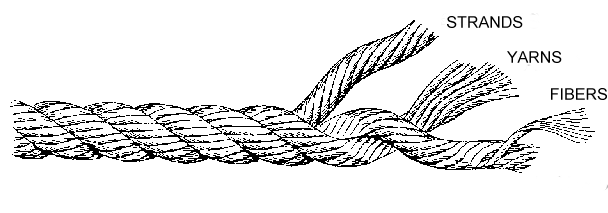
Let's see why we need variance in the first place. There is high correlation between the composition of various chemicals in the body to the personalities and behaviors we manifest. Nature which has limited resources. For life to be persistent it is important that life can sustain on variety of resources so that Nature can efficiently "refill the resources". Based on the refilling abilities of Nature our bodies evolved to incorporate variance in the needs. We are not that variant in terms of needs for oxygen for e.g. since Nature seems to be very efficient in that resource regeneration. Hence the variance in our needs can be roughly traced to the variance in the availability of resources in our Natural neighborhood. Since Nature cannot handle all (varied) needs of all the life in a global way efficiently it decentralizes need fulfilling activities into the life forms itself. In other words the body chemical compositions are evolved in such a way as to locally have a cycle of supply and demand: starting from the most obvious examples, some are male, some are female, some have strong feelings about environment, some have strong feelings about high energy colliders creating black holes (see here), some are interested in making money, some are interested in education, some are spiritual, some are materialistic, some are good in theory, some are good in practice etc. etc. So to summarize we can think of local variances in needs is an efficient design of Nature for long-term sustenance of life. Something like: For a rope to be strong the individual fibers and yards and then strands have to be intertwined with friction among them. One other important thing with variance is that variance has to be "normal" locally so as to have the benefit of decentralization otherwise it would demand redundant effort. For e.g. if the friction between the fibers or yarns or strands is too high the rope might self-destruct under it's own friction without additional effort.
Now since the cycles of supply and demand usually are formed locally we might get stuck at local optima (which would be evident by diminishing returns in the cluster etc.). Change in temporal dimension would shuffle around the neighborhoods and gives us a chance to get out those local optima and form new cycles. Eventually we hope to find global optimum configuration. But as it is well known such optimization problems though can be "solved" require exponential amount of time in principle. So enjoy the journey and don't be scared to enter new cycles. It also helps to keep in mind an important property of stochastic optimization methods that not every move is better than the previous move which precisely is its strength. Of course blind (ignorant) change is not great since there are lot of probabilities (based on evidences, priors and likelihoods) you could compute to figure out the types of changes (moves) to reduce the mixing time.
I would ask the readers to pay attention to the words "efficient" and "local" as they carry the central message. Of course what all I discussed above (or in general in this blog) is not always new but is based on original thought. Lot of economists study such behaviors professionally and it would greatly help design your lives better by reading papers in such fields (I don't though): that's why the mathematicians who study and contribute to understanding such patterns are eligible Nobel prizes.
Let's see why we need variance in the first place. There is high correlation between the composition of various chemicals in the body to the personalities and behaviors we manifest. Nature which has limited resources. For life to be persistent it is important that life can sustain on variety of resources so that Nature can efficiently "refill the resources". Based on the refilling abilities of Nature our bodies evolved to incorporate variance in the needs. We are not that variant in terms of needs for oxygen for e.g. since Nature seems to be very efficient in that resource regeneration. Hence the variance in our needs can be roughly traced to the variance in the availability of resources in our Natural neighborhood. Since Nature cannot handle all (varied) needs of all the life in a global way efficiently it decentralizes need fulfilling activities into the life forms itself. In other words the body chemical compositions are evolved in such a way as to locally have a cycle of supply and demand: starting from the most obvious examples, some are male, some are female, some have strong feelings about environment, some have strong feelings about high energy colliders creating black holes (see here), some are interested in making money, some are interested in education, some are spiritual, some are materialistic, some are good in theory, some are good in practice etc. etc. So to summarize we can think of local variances in needs is an efficient design of Nature for long-term sustenance of life. Something like: For a rope to be strong the individual fibers and yards and then strands have to be intertwined with friction among them. One other important thing with variance is that variance has to be "normal" locally so as to have the benefit of decentralization otherwise it would demand redundant effort. For e.g. if the friction between the fibers or yarns or strands is too high the rope might self-destruct under it's own friction without additional effort.
Now since the cycles of supply and demand usually are formed locally we might get stuck at local optima (which would be evident by diminishing returns in the cluster etc.). Change in temporal dimension would shuffle around the neighborhoods and gives us a chance to get out those local optima and form new cycles. Eventually we hope to find global optimum configuration. But as it is well known such optimization problems though can be "solved" require exponential amount of time in principle. So enjoy the journey and don't be scared to enter new cycles. It also helps to keep in mind an important property of stochastic optimization methods that not every move is better than the previous move which precisely is its strength. Of course blind (ignorant) change is not great since there are lot of probabilities (based on evidences, priors and likelihoods) you could compute to figure out the types of changes (moves) to reduce the mixing time.
I would ask the readers to pay attention to the words "efficient" and "local" as they carry the central message. Of course what all I discussed above (or in general in this blog) is not always new but is based on original thought. Lot of economists study such behaviors professionally and it would greatly help design your lives better by reading papers in such fields (I don't though): that's why the mathematicians who study and contribute to understanding such patterns are eligible Nobel prizes.
Saturday, June 28, 2008
Being yourself
It is widely accepted that being someone we are not, is very uncomfortable. But it is important to first understand who we actually are. Richard Feynmann once said "What I cannot make I do not understand." To actually understand who we are, we need a process (life) that we actually can analyze. We need to be someone who can sustain the process and focus on aspects that are most dear to us simultaneously. Both of these sub-processes give us some understanding of ourselves and can help us in being ourselves. So there could be cases when you are not being yourself. For e.g. when the sustaining process is not interacting with the focusing process properly or when one of the processes is not functioning.
Based on the situations you are in you get leverage and help in running the two sub-processes. You are usually in the situations you choose to be. If you choose to be emotional you get leverage on the second sub-process. If you choose to be less emotional you get leverage on the first sub-process. But as I said before the leverage on one process could be nullified if the other process is not taken care of. The leverage you get is usually in the form of experience (learned concepts from the data we are exposed to). So for e.g. having a leverage emotionally means that you are very experienced in various kinds of emotions and actually (un-emotionally) use those experiences in focusing properly. But gaining experiences is not easy either. It is well know in the learning theory that even though we need on polynomial number of sample data for learning concepts (hypotheses) it's actually hard to find the concepts. Experiencing is a hard task and so is being yourself.
Based on the situations you are in you get leverage and help in running the two sub-processes. You are usually in the situations you choose to be. If you choose to be emotional you get leverage on the second sub-process. If you choose to be less emotional you get leverage on the first sub-process. But as I said before the leverage on one process could be nullified if the other process is not taken care of. The leverage you get is usually in the form of experience (learned concepts from the data we are exposed to). So for e.g. having a leverage emotionally means that you are very experienced in various kinds of emotions and actually (un-emotionally) use those experiences in focusing properly. But gaining experiences is not easy either. It is well know in the learning theory that even though we need on polynomial number of sample data for learning concepts (hypotheses) it's actually hard to find the concepts. Experiencing is a hard task and so is being yourself.
Monday, June 23, 2008
Streaks of thought: Streak 18
Sometimes even though we know we have almost all reasons to change, we find it hard to change because of just one missing (wrong) reason: A reason to convince others around us that we need change.
The reason is wrong because others will not understand until you actually change and show them the benefits. So don't get stuck in the dead-lock.
The reason is wrong because others will not understand until you actually change and show them the benefits. So don't get stuck in the dead-lock.
Wednesday, May 28, 2008
A reason to be fan of computer science
Having computational perspectives in life can help design your lives so nicely! Here's a solid example which many singles can use, thanks to Scott for including the dating protocol in his lecture 18 :)
This can not only help in dating but also classifying people into jerks and reasonable ones. If the dating protocol does not work then the conclusion is at least one of them is a jerk, hypocrite, liar or whatever in which case you at least have a solid reason not to worry. Of course it is not necessary that you won't worry though!
This can not only help in dating but also classifying people into jerks and reasonable ones. If the dating protocol does not work then the conclusion is at least one of them is a jerk, hypocrite, liar or whatever in which case you at least have a solid reason not to worry. Of course it is not necessary that you won't worry though!
Monday, May 26, 2008
Depth of knowledge
The amount of knowledge one has is measured in the number of truths he can handle efficiently in some beneficial way. Truths are deduced essentially using logic even though the deduction process is not always deterministic. The depth of knowledge one has can be measured by quantifying the resources needed for the deduction process: the most important resource being time.
A person is said to have deeper knowledge than another if the other person needs more time for deduction than the former. Having deeper knowledge hence can buy you time! To increase the depth of your knowledge you need to improve your deducing abilities and for that you need to constantly practice it so that you become fast. One useful improvement technique is memoization where you do not recompute the same sub-problem every time: if you solved it once just remember and use it. Don't resolve the same puzzle over and over again. The goal is to constantly build a global lookup table for your life. This will help not only you but also those with whom you can share the table.
This is basically why experience can help increase your depth of knowledge.
A person is said to have deeper knowledge than another if the other person needs more time for deduction than the former. Having deeper knowledge hence can buy you time! To increase the depth of your knowledge you need to improve your deducing abilities and for that you need to constantly practice it so that you become fast. One useful improvement technique is memoization where you do not recompute the same sub-problem every time: if you solved it once just remember and use it. Don't resolve the same puzzle over and over again. The goal is to constantly build a global lookup table for your life. This will help not only you but also those with whom you can share the table.
This is basically why experience can help increase your depth of knowledge.
Subscribe to:
Posts (Atom)